رفتن به محتوا
فلک‌بینfalakbin.ir
کانال تلگرام

صفحهٔ اصلی فلک‌بین

آسمان

فضا

زمین

دانش

ابزار

حساب و فرمول

تاریخ و زمان

واحد و اندازه

ریاضی

آسمان و فضا

بدن

آزمایشگاه

آسمان

منظومه و فضا

زمین

نور و کیهان

کیهان و اخترفیزیک

فلک‌بین

کانال فلک‌بین در تلگرام

تقویم تاریخ علم

در چنین روزی، ۷ اکتبر

امسال ۱۵ مهر

رویدادها، زادروزها و درگذشت‌های تاریخ علم در ۷ اکتبر، از کهنه به تازه، به روایت بات تقویم علمی؛ هر سال همین روز داستان تازه‌ای به این صفحه اضافه می‌شود.

۱۸۸۵فیزیک و شیمی · زادروز · ۱۵ مهر ۱۲۶۴

بور و پرسش ساختار اتم

۱۴۱ سال پیش در چنین روزی، در سال ۱۸۸۵، نیلز بور (Niels Bohr)، فیزیک‌دان دانمارکی، به دنیا آمد؛ کسی که نظریهٔ کوانتومی را به مسئلهٔ ساختار اتم و مولکول پیوند زد. در این نظریه، انرژی یک سامانه نمی‌تواند هر مقداری داشته باشد و به مقدارهای معینی محدود است. بور با به‌کارگیری این ایده برای توضیح اتم، راهی تازه برای بررسی ساختار آن گشود. او همچنین نظریهٔ اتمی بور و مدل مایع هسته را پروراند. اهمیت کارش در شناخت ساختار اتم‌ها و تابشی که از آن‌ها گسیل می‌شود چنان بود که جایزهٔ نوبل فیزیک را دریافت کرد.

۱۹۵۴ریاضی و فناوری · رویداد · ۱۵ مهر ۱۳۳۳

ماشین‌حساب تماماً ترانزیستوری آی‌بی‌ام

۷۲ سال پیش در چنین روزی، در سال ۱۹۵۴، آی‌بی‌ام اولین ماشین‌حساب تماماً ترانزیستوری خود را به نمایش گذاشت. این ماشین‌حساب تنها ۵ درصد از انرژی ماشین‌حساب‌های الکترونیکی مشابه را مصرف می‌کرد. این پیشرفت مهندسی نقش مهمی در توسعه تکنولوژی‌های محاسباتی ایفا کرد و سه سال بعد، در سال ۱۹۵۷، آی‌بی‌ام اولین ماشین‌حساب تجاری تماماً ترانزیستوری را به بازار عرضه کرد. این نوآوری سرآغاز انقلابی در دنیای محاسبات و الکترونیک شد.

۱۹۵۹نجوم و فضا · رویداد · ۱۴ مهر ۱۳۳۸

نخستین نگاه به سمت پنهان ماه

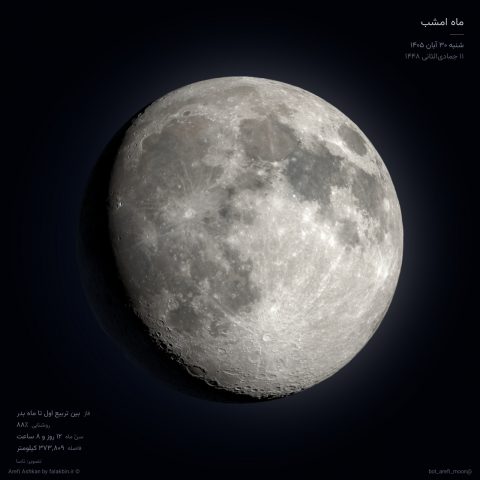
۶۷ سال پیش در چنین روزی، در سال ۱۹۵۹، فضاپیمای لونا ۳ (Luna 3) نخستین عکس‌های سمت پنهان ماه را گرفت؛ بخشی که از زمین دیده نمی‌شود، چون ماه هنگام گردش به دور زمین همواره یک روی خود را به ما نشان می‌دهد. فضاپیما پس از گذشتن از کنار ماه، از فاصلهٔ ۶۳٬۵۰۰ کیلومتری به عقب نگاه کرد و در ۴۰ دقیقه، ۲۹ عکس از آن سمتِ روشن‌شده با نور خورشید گرفت. عکس‌ها در خود فضاپیما ظاهر شدند و سپس با امواج رادیویی به زمین رسیدند. تصویرها کم‌کیفیت و پرنویز بودند، اما ۷۰ درصد آن ناحیه را پوشش دادند و برای نخستین بار بعضی از عوارضش را آشکار کردند.

رویدادهای دیگر این روز

  • ۱۹۲۶امروز سالگرد درگذشت امیل کریپلین (Emil Kraepelin) است؛ روان‌پزشکی که میان اسکیزوفرنی و روان‌پریشی شیدایی‌ـ‌افسردگی تمایز گذاشت.
  • ۱۹۳۹زادروز هارولد کروتو (Harold Kroto)، شیمی‌دان سهیم در کشف فولرن‌ها، ساختارهای تازه‌ای از کربن با اتم‌های چیده‌شده در پوسته‌های بسته، است.
  • ۲۰۰۸سیارک ۲۰۰۸ تی‌سی۳ (2008 TC3) بر فراز بیابان نوبیه منفجر شد؛ برای نخستین بار، برخورد یک سیارک پیش از ورودش به جو پیش‌بینی شده بود.
  • ۲۰۲۰ماریو مولینا (Mario Molina)، شیمی‌دانِ هشداردهنده دربارهٔ تهدید گازهای سی‌اف‌سی برای لایهٔ اوزون، در چنین روزی درگذشت.

چهار قرن در یک نگاه

۷ اکتبر در گذر سده‌ها

نقطه‌های رنگی داستان‌هایی‌اند که بات گفت، به رنگ رشته‌شان؛ نقطه‌های خاکستری همهٔ رویدادها، زادروزها و درگذشت‌هایی که منبع‌ها برای این روز داشتند. موشواره را روی هر نقطه نگه دارید.

۱۶۰۰۱۶۵۰۱۷۰۰۱۷۵۰۱۸۰۰۱۸۵۰۱۹۰۰۱۹۵۰۲۰۰۰گفته‌شده رویدادزادروزدرگذشت1956 — Clarence Birdseye — American naturalist and inventor of the deep freezing food method and co-founder of General Foods Corp. On Arctic trips as a field naturalist for the United States government, he noticed that freshly caught fish, when placed onto the A 1885 — Niels Bohr — Niels Henrik David Bohr was a Danish physicist who was the first to apply the quantum theory, which restricts the energy of a system to certain discrete values, to the problem of atomic and molecular structure. For this work he received the N 1847 — Alexandre Brongniart — French mineralogist, geologist, and naturalist, who first arranged the geologic formations of the Tertiary Period (from 66.4 to 1.6 million years ago) in chronological order and described them. He made the first systematic study of 1954 — Transistor calculator — In 1954, in Poughkeepsie, IBM displayed a large all-transistor calculator needing only 5% of the power of comparable electronic ones. Three years later, in 1957, IBM introduced the IBM 608, the first all-transistor commercial calcu 1950 — Willis Haviland Carrier — American inventor who initiated modern building air conditioning. He graduated in 1901 with an M.E. In 1902, he designed his first system to control temperature and humidity in a Brooklyn printing plant. By 2 Jan 1906, he patente 1939 — Harvey Cushing — Harvey Williams Cushing was an American neurosurgeon who was a pioneer of neurosurgery, and studied blood pressure. His clinical contributions are legendary: the use of x-rays in surgical practice, physiological saline for irrigation duri 1920 — Yves Delage — French zoologist known for his research and elucidation of invertebrate physiology and anatomy. He also discovered the equilibrium-stabilizing function of the semicircular canals in the inner ear (1886). Delage studied circulation in crustac 1965 — Jesse Douglas — American mathematician who was awarded one of the first two Fields Medals in 1936 for solving the Plateau problem. which had first been posed by the Italian-French mathematician Joseph-Louis Lagrange in 1760. The Plateau problem is one of 1894 — Oliver Wendell Holmes — American physician and writer was best-known as an essayist-poet, but in medicine was famous for his 1843 article 'The Contagiousness of Puerperal Fever,' concerning the high mortality of women giving birth in hospitals. He asserte 1911 — John Hughlings Jackson — English neurologist whose studies of epilepsy, speech defects, and nervous-system disorders arising from injury to the brain and spinal cord remain among the most useful and highly documented in the field. He was one of the first 1994 — Niels K. Jerne — Niels Kaj Jerne was a Danish immunologist who shared (with César Milstein and Georges Köhler) the 1984 Nobel Prize for Physiology or Medicine. Jerne has provided three important theories of immunology. (1) Natural selection theory of anti 1926 — Emil Kraepelin — German psychiatrist, one of the most influential of his time, who developed a classification system for mental illness that influenced subsequent classifications. Kraepelin made distinctions between schizophrenia and manic-depressive psyc 1939 — Sir Harold W. Kroto — English chemist who shared (with Richard E. Smalley and Robert F. Curl, Jr.) the 1996 Nobel Prize for Chemistry for their joint discovery of the carbon compounds called fullerenes. These new forms of the element carbon contain 60 or 1927 — R. D. Laing — Ronald David Laing was a British psychiatrist who was noted for his alternative approach to the treatment of schizophrenia. His first book, The Divided Self, was an attempt to explain schizophrenia by using existentialist philosophy to vivid 1822 — Rudolf Leuckart — Rudolf (Karl Georg Friedrich) Leuckart was a German zoologist and teacher who initiated the modern science of parasitology. As a youth, he showed an early interest in zoology and in insects in particular. While attending medical school a 1959 — Moon's dark side — In 1959, the dark far side of the Moon was photographed for the first time and pictures relayed back to Earth by Russia's Luna 3 spacecraft. After passing the moon, the Luna 3 looked back from a distance of 63,500 km to take 29 photos o 1855 — François Magendie — French physiologist was first to demonstrate the distinct functions of the spinal nerve roots. With section experiments he confirmed Charles Bell’s idea: anterior roots are motor, dorsal roots sensory (the Bell-Magendie law). A pioneer 1858 — Charles Marvin — American meteorologist and inventor who invented the clinometer that figures height of clouds over airports. He was Chief of the U.S. Weather Bureau (1913-34). He worked on, and wrote about, the Robinson cup anemometer, from early in his 1601 — Florimond de Beaune — Florimond de Beaune was a French jurist and amateur mathematician who produced the first important introduction to Descartes' cartesian geometry. 1983 — George O. Abell — George O. Abell, American astronomer, professor, science popularizer, and skeptic (born 1927) — George Ogden Abell was an American astronomer and professor. He taught at UCLA, primarily as a research astronomer. He earned his B.S. in 195 2020 — Mario J. Molina — Mario J. Molina received the 1995 Nobel Prize in Chemistry "for their work in atmospheric chemistry, particularly concerning the formation and decomposition of ozone". Mario Molina, Mexican chemist (born 1943) — Mario José Molina-Pasqu 2008 — George E. Palade — George E. Palade received the 1974 Nobel Prize in Physiology or Medicine "for their discoveries concerning the structural and functional organization of the cell". 2010 — Soyuz TMA-01M — Soyuz TMA-01M (2010 Russian crewed spaceflight to the ISS). Launched on 2010-10-07. — Soyuz TMA-01M was a Soyuz flight that transported three members of the Expedition 25 crew to the International Space Station. TMA-01M was the 107th fligh 1939 — John Hopcroft — John Hopcroft, American computer scientist and author — John Edward Hopcroft is an American theoretical computer scientist. His textbooks on theory of computation and data structures are regarded as standards in their fields. He is a profe 2019 — S/2004 S 26 — S/2004 S 26 (moon of Saturn). Discovered on 2019-10-07. S/2004 S 29 (moon of Saturn). Discovered on 2019-10-07. — Saturn LVIII, provisionally known as S/2004 S 26, is the outermost numbered natural satellite of Saturn. Its discovery was an 2025 — Sir John B. Gurdon — Sir John B. Gurdon received the 2012 Nobel Prize in Physiology or Medicine "for the discovery that mature cells can be reprogrammed to become pluripotent". 1995 — Gerard Henri de Vaucouleurs — French-born U.S. astronomer whose pioneering studies of distant galaxies contributed to knowledge of the age and large-scale structure of the universe. He produced three Reference Catalogues of bright galaxies (1964, 1976, 19 2008 — 2008 TC3 — 2008 TC3 exploded above the Nubian Desert in Sudan, in the first time that an asteroid impact had been predicted prior to atmospheric entry. — 2008 TC3 was an 80-tonne (80-long-ton; 90-short-ton), 4.1-meter (13 ft) diameter asteroid that entere 1958 — Project Mercury — The U.S. crewed space-flight project is renamed to Project Mercury. — Project Mercury was the first human spaceflight program of the United States, running from 1958 through 1963. An early highlight of the Space Race, its goal was to put 2002 — Space Shuttle Atlantis — The Space Shuttle Atlantis launches on STS-112 to continue assembly of the International Space Station. — Space Shuttle Atlantis is a retired Space Shuttle orbiter vehicle which belongs to NASA, the spaceflight and space explorati ۱۸۸۵ — بور و پرسش ساختار اتم ۱۹۵۴ — ماشین‌حساب تماماً ترانزیستوری آی‌بی‌ام ۱۹۵۹ — نخستین نگاه به سمت پنهان ماه ۱۹۲۶ — امروز سالگرد درگذشت امیل کریپلین (Emil Kraepelin) است؛ روان‌پزشکی که میان اسکیزوفرنی و روان‌پریشی شیدایی‌ـ‌افسردگی تمای… ۱۹۳۹ — زادروز هارولد کروتو (Harold Kroto)، شیمی‌دان سهیم در کشف فولرن‌ها، ساختارهای تازه‌ای از کربن با اتم‌های چیده‌شده در پوس… ۲۰۰۸ — سیارک ۲۰۰۸ تی‌سی۳ (2008 TC3) بر فراز بیابان نوبیه منفجر شد؛ برای نخستین بار، برخورد یک سیارک پیش از ورودش به جو پیش‌بین… ۲۰۲۰ — ماریو مولینا (Mario Molina)، شیمی‌دانِ هشداردهنده دربارهٔ تهدید گازهای سی‌اف‌سی برای لایهٔ اوزون، در چنین روزی درگذشت.
نجوم و فضافیزیک و شیمیزیست و پزشکیزمینریاضی و فناوریمنبع‌ها

روزهای دیگر سال

هر روزی که بات دربارهٔ آن نوشته، صفحهٔ خودش را دارد.

تقویم علمی هر روز در تلگرام

هر روز در تلگرام

این را هر روز در تلگرام بگیرید

تقویم علمی تاریخ @onthisday_arefi_bot: تاریخ علم در همین روز، از Today in Science History، ویکی‌پدیا، ویکی‌داده، MacTutor و بنیاد نوبل: یکی دو رویداد مهم با شرح کامل، با اولویت نجوم و فضا، مرور کوتاه چند روید… رایگان، برای خودتان، گروه یا کانالتان.

دانش

امروز در بخش دانش

فلک‌بین

در گوشه‌های دیگر فلک‌بین